
The County beat
independent civic journalism project
- morgan county, indiana -
Articles
Issue No. 7

Issue No. 6

Issue No. 5

Issue No. 4

Issue No. 3

Issue No. 2

Issue No. 1

About
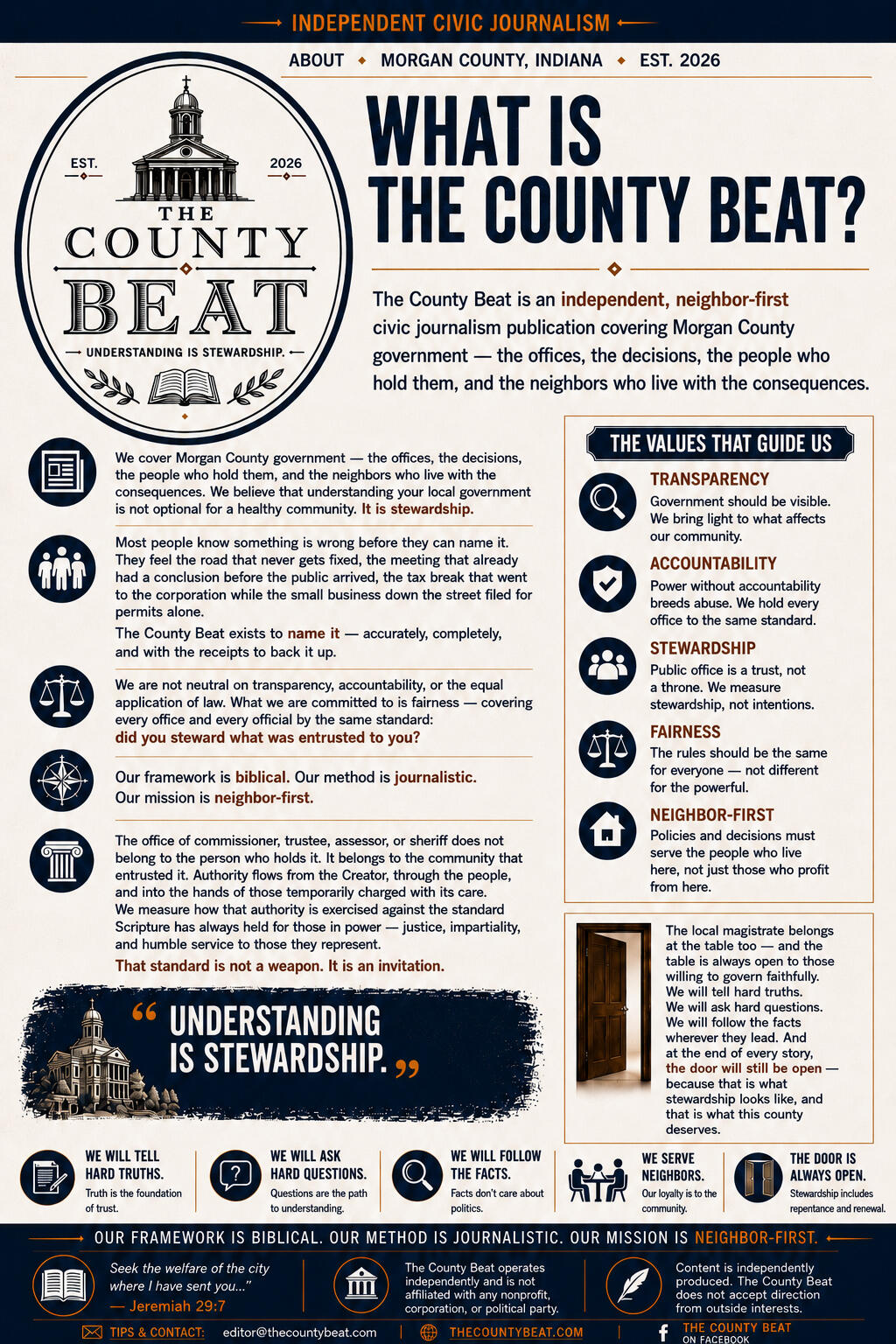
The County Beat covers Morgan County government — the offices, the decisions, the people who hold them, and the neighbors who live with the consequences.
We believe understanding your local government is not optional for a healthy community. It is stewardship.
Our framework is biblical. Our method is journalistic. Our mission is neighbor-first.
Founded and edited by Sean Walker, a Morgan County resident and neighbor.
Contact
Have a tip, a question, or a document we should see? Reach out.
Issue No. 7
What Is a Plan Commission For?
The Morgan County Plan Commission, the Western TIF,
and the Question of Informed Authority
"For rulers are not a terror to good conduct, but to bad. Would you have no fear of the one who is in authority? Then do what is good, and you will receive his approval, for he is God's servant for your good."
— Romans 13:3–4
Romans 13 teaches that governing authority is not self-originating. It is instituted — given for a purpose, on behalf of those it serves. The apostle Paul writes that the governing authority is God's servant for your good. That service is not incidental to the authority. It is the reason the authority exists.
Indiana's own Constitution declares in Article 1, Section 1 that all power is inherent in the People — that government is instituted for the peace, safety, and well-being of the people, and that they have at all times an indefeasible right to alter or reform it when the public good requires.
The Morgan County Plan Commission holds its authority on that dual foundation. It was instituted by statute to serve the residents of unincorporated Morgan County. Its members were placed there by officials who themselves hold delegated authority from the same source.
What follows is not a verdict on any person. Every individual named in this article bears the image of God and is treated as such. What follows is an examination of whether the authority this body holds was exercised as designed — as a servant of the public good — or whether it has functioned as a formality while the work of governance was done by others.
The distinction matters because the residents of Morgan County are not abstractions. They are neighbors. They live on the roads that will be reshaped by the decisions flowing through this process. They drink from the aquifer that sits beneath the campus this financial architecture was built to support. They are the good the authority is meant to serve.
— The Editor
Part One
What the Law Requires
On the evening of June 8, 2026, the Morgan County Plan Commission took up Resolution 2026-01 — a conformance determination for the Western Morgan County Economic Development Area, tied directly to what county officials have described as the largest economic development project in Morgan County's history.
Before the vote, members of the commission needed something more fundamental than an analysis of the resolution before them. They needed an explanation of what they were being asked to do.
The explanation was provided by Chelsey Manns, consultant to the Morgan County Redevelopment Commission.
The vote was 7-1. One member dissented. No reason was entered into the record.
The question Morgan County residents deserve to ask is not whether the TIF is good or bad for this community. The question is whether the body that approved it was actually governing — or performing governance while someone else drove.
The Morgan County Advisory Plan Commission exists by authority of Indiana Code IC 36-7-4-100 et seq. — a fact the commission's own Rules and Procedures acknowledge in their opening article. The commission's powers and duties flow from IC 36-7-4-400 series, which grants it authority over the land use decisions that shape how this county grows, who bears the costs of that growth, and whether development serves the community's stated vision for itself.
The commission's own Unified Development Ordinance, adopted January 1, 2022 — a document that bears the names of Terry Brock, Melanie DePoy, and Dustin Frye among its Technical Committee — states the commission's intent plainly: to "guide the orderly, responsible, and sustainable development and redevelopment in accordance with the Morgan County Comprehensive Plan and the Morgan County Thoroughfare Plan."
Within the Tax Increment Financing approval process governed by Indiana Code IC 36-7-14, the Plan Commission holds a specific statutory role. After a Redevelopment Commission adopts a declaratory resolution creating an economic development area and allocation area, the matter comes before the Plan Commission for a conformance determination. This is a legal finding — not a recommendation, not a courtesy review — that the proposed area and its economic development plan conform to the community's plan of development.
That finding requires something. It requires that the commission know its own plans. It requires that members arrive having compared the proposed economic development area against the comprehensive plan's land use designations, the thoroughfare plan's identified corridors, and the community's stated vision for western Morgan County. It requires the capacity for independent judgment — including the capacity to say no.
The commission's own Rules and Procedures address this directly. Article 2 establishes attendance requirements and member responsibilities. Article 4 outlines conflict of interest provisions under IC 36-7-4-223, requiring members to recuse themselves when they have a direct or indirect financial interest in the outcome of a zoning decision. Article 3 states plainly: "The PC shall contract with independent legal counsel as needed."
These are not aspirational guidelines. They are the commission's own governing standards, adopted by Terry Brock as President and Maxwell as Secretary on August 11, 2025 — less than a year before Monday's meeting. The standard was written. The authority was real. The question is what happened to both of them on June 8.
Part Two
A Pattern in the Public Record
Monday night was not the first time the Morgan County Plan Commission faced a consequential decision about the development now known as Project Louie without the regulatory framework in place to evaluate it properly. It was the third.
In February 2025, the commission voted 7-1 to recommend rezoning 390 acres of agricultural land along North Antioch Road for a data center campus. The petitioner was Woodland Caribou LLC — a shell company whose identity and ultimate ownership were not publicly disclosed at the time of the vote. The approval came through a Planned Unit Development designation — a mechanism the UDO describes as intended for development that "may not correspond with" standard use requirements. The PUD is, by design, an exception to the standard framework.
The problem is that no standard framework existed for the commission to depart from. The Morgan County Unified Development Ordinance — adopted January 1, 2022, bearing the names of several commission members on its Technical Committee — contains no data center use classification. Not in permitted uses. Not in special exception uses. Not in any zoning district. The commission was asked to evaluate a hyperscale industrial campus covering 390 acres against a regulatory framework that had no category for what was being proposed.
The appropriate path, before hearing that petition, was available. The commission could have recognized that the petition represented a use type its own framework had not contemplated. It could have tabled the petition. It could have initiated a UDO amendment to establish data center use standards — a process that itself requires public notice and hearing, giving residents a meaningful basis for input. It could have ensured the comprehensive plan and thoroughfare plan were adequate to the scale of what was being proposed. Then, with a framework in place, it could have heard the petition with a standard against which to measure it and a public record that meant something.
Instead the PUD was approved. At that February hearing, resident Sean Walker — the editor of this publication, who lives on North Antioch Road directly across from the campus — stated publicly: "We have no time to even think about it." At least one resident later filed a lawsuit alleging the commissioners disregarded the county's comprehensive plan and that the rezoning was arbitrary.
In September 2025, the commission voted 5-2 to recommend an additional 158-acre expansion — again as a PUD, again without a data center use classification in the UDO, again through the exception mechanism. Two hours of public comment preceded the vote. Five members voted yes. Bill Rumbaugh, who voted in favor, acknowledged from the dais: "I'm up here to make a very painful vote."
Now, in June 2026, the same body voted 7-1 to advance the TIF financial architecture surrounding that campus — after needing the applicant's consultant to explain the process it was asked to execute.
Three votes. Three opportunities to function as the independent filter Indiana law asks this body to be. Three times the commission moved forward without a framework adequate to the development before it, and without preparation or independent deliberation being clearly visible in the public record.
This is not a pattern of individual failure. It is a pattern of institutional design — or the absence of it. A body whose public record shows no visible training, no engagement of independent counsel for this proceeding, and no regulatory framework adequate to the development it was asked to evaluate, will tend to function as a ceremonial feature. The appearance of oversight without its substance. The form of a check without its force.
Part Three
The Conformance Question the Record Does Not Show
The purpose of the Plan Commission's role in the four-step TIF process is a specific one: to determine whether the proposed economic development area conforms to the community's plan of development.
Not the allocation area. Not the data center campus. The economic development area — the territory where TIF funds can be spent.
In this case, that territory encompasses Adams, Monroe, and the western portion of Brown Townships, west of the Mooresville town boundary. It is a large swath of western Morgan County.
The 2019 Morgan County Comprehensive Plan — adopted the same day as the Thoroughfare Plan, bearing the names of Terry Brock, Melanie DePoy, and Dustin Frye on its steering committee and plan commission acknowledgements — is explicit about what this territory is for.
The comp plan designates the western and southern portions of the county as low intensity areas. Its own language states: "Low intensity areas encourage preservation of prime farmland and environmentally sensitive areas primarily located in the western and southern portion of the County." Its prime agricultural land map identifies the northwestern portion of the county — territory that includes much of the western economic development area — as prime farmland.
The comp plan's Goal 1, Objective 1.3 states that "land uses such as industrial, commercial and most types of residential should be encouraged only in areas appropriate for growth and supported with infrastructure." The same goal calls for "protecting natural resources and prime agricultural land."
Goal 6, Objective 6.3 — which addresses development along interstate interchanges — states that such development "should focus on attracting job opportunities for the County while also ensuring development patterns promote the aesthetic quality of the County and continues to serve the existing communities."
The conformance question the Plan Commission was statutorily required to answer on Monday night was this: does designating a large swath of low-intensity, prime agricultural western Morgan County as an economic development area — where TIF funds will be directed toward infrastructure to support the county's largest industrial development — align with the comprehensive plan's vision for that territory? Does it serve the existing communities the comp plan says corridor development must serve? Does it protect the prime farmland the comp plan says must be protected?
These are not hostile questions. They are the questions the conformance determination exists to answer.
The Strongest Defense of the Commission's Vote
The Plan Commission's conformance role is narrow by design. It is not an appellate body for the data center approval. It was not asked to re-litigate the rezone, evaluate Google's business case, or weigh the merits of TIF financing. The legal question before it was bounded: does the proposed western economic development area generally conform to the county's existing planning documents? Chelsey Manns pointed to the thoroughfare plan's road concerns in that corridor as evidence of conformance. That reference has a genuine basis — the 2019 Thoroughfare Plan does identify roads in the western corridor as needing attention, and a TIF spending zone that would fund road improvements in that area is not an obviously unreasonable fit. The commission's role, on that narrow reading, may have been adequately discharged.
The County Beat is not arguing that the Western Morgan County Economic Development Area necessarily fails the conformance test. The argument is more precise: the public record should demonstrate that the question was meaningfully examined by an independent body.
What is visible in Monday night's transcript does not show that examination. Whether it occurred privately before the meeting is not something the public record can confirm or refute.
The public record is the only window residents have into whether their independent check is functioning. On Monday night, that window showed orientation, not deliberation.
The thoroughfare plan road concerns were identified in 2019 in response to projected residential and commercial growth along the I-70 corridor — not in anticipation of the infrastructure demands of a hyperscale industrial campus. Whether the thoroughfare plan's existing framework is adequate to what has actually been built, or whether it needs to be revisited entirely in light of it, was not visible in the public record of Monday's meeting.
The comprehensive plan's vision for western Morgan County. The thoroughfare plan's adequacy given what has changed since 2019. The question of whether this spending zone serves or strains the communities it is meant to benefit.
None of it surfaced in the public record.
What surfaced, instead, was how the process works.
Part Four
The Question of Preparation, Composition, and Appointment
The Plan Commission does not appoint itself.
The members who sat in that room Monday night were placed there by the same county commissioners and county council members whose priorities and projects flow through this body for review. Under IC 36-7-4-208(b), the commission's composition is prescribed by statute — one County Commissioner representative, one County Council representative, the County Surveyor as ex-officio member, one County Agricultural Extension Educator, and five citizen members appointed by the County Executive.
According to the commission's current published membership, six of nine seats are filled by or at the appointment of the County Commissioners. Terry Brock serves ex-officio as County Surveyor. Joe Crone holds the County Council representative seat. Citizen members Melanie DePoy, Dustin Frye, Brian Patrick, and Bill Rumbaugh were all appointed by the County Commissioners.
One seat — held by Jason Maxwell, whose published term expired December 31, 2025 — does not appear to have been filled as of this writing, according to the commission's publicly posted membership. Eight members were present Monday night.
The appointing authorities have never had to answer publicly: what is the standard for Plan Commission membership, and does it include the capacity for genuinely independent judgment when independence is costly?
Some members carry professional backgrounds in industries directly shaped by the kinds of decisions this commission makes. The commission's own conflict of interest provision under IC 36-7-4-223 states that a member has a conflict of interest when they are "biased or prejudiced or otherwise unable to be impartial" or have "a direct or indirect financial interest in the outcome of the zoning decision." The standard exists in their own governing document. Whether it was applied Monday night — or in the months of meetings that preceded it — is a question the public record does not answer.
The first is preparation — did members understand the authority they held when they walked in? The public record of Monday night does not demonstrate that they did.
The second is composition — is the body structured to exercise that authority independently? That question belongs to the appointing authorities.
The third is appointment — who holds appointment power, and have they ensured this body is equipped for independent judgment? The officials who make those appointments are the same officials whose priorities this body is meant to check.
A board whose preparation is not evident in the public record, whose potential conflicts of professional interest are not addressed in that same record, and whose members were appointed by the same officials whose projects come before it — that is not three separate problems. It is one problem with three visible symptoms. The accountability for that problem rests not with the volunteers sitting in those chairs on a Monday evening. It rests with the officials who put them there. Whether those officials provided training, independent counsel, or the structural conditions to do what Indiana law asks is a question they should be prepared to answer.
The public instrument affected is not minor. The economic development area spans multiple townships. The allocation area captures increment from an 885-acre campus. The financial horizon is generational. The decisions flowing through this four-step process will shape Morgan County for decades.
Continued in Part Three
Part Five
The Instrument and Its Geography
What was approved Monday night was not the TIF itself. It was the second of four steps required to create the Western Morgan County Economic Development Area.
The geography matters and has been a source of confusion in public discussion. The two distinct areas serve different functions.
Two Distinct Areas
Allocation Area (~885 acres) — where TIF increment is captured. This is the Project Louie campus footprint. When assessed values within this area rise above the established base, the increment is redirected into the TIF rather than flowing to the general fund and taxing units.
Economic Development Area — Adams, Monroe, and western Brown Townships, west of the Mooresville town boundary. This is where TIF funds can be spent. This is not where the money comes from. It is where the money goes. This is also the territory the conformance determination was asked to evaluate.
The primary stated use of funds is a study and potential construction of a truck route from I-70 and SR-39 to SR-67 to route commercial traffic through and around Mooresville. That route, if built, will require cooperation among three separate RDCs — Morgan County, Monrovia, and Mooresville. Jean Ryder, identified as the Monrovia RDC vice chair, was named as a participant in early conversations about that coordination. The Monrovia dimension of this story is not closed.
Monrovia was not included in this TIF by institutional design. Because Monrovia has its own Redevelopment Commission, Indiana law prevents the county RDC from establishing a TIF within its municipal limits. Monrovia absorbs development pressure at its doorstep while the county captures the increment and spends it on western infrastructure. Monday night's proceedings confirmed that TIF does not preclude annexation — legal counsel for the RDC stated clearly that any municipality can annex within the economic development area under normal state procedures. What the intersection of Monrovia's own TIF and the county's new western district would look like under annexation has not been publicly examined.
Part Six
One Voice That Sounded Different
Near the close of Monday's meeting, Commissioner Mike Kirsch asked for the floor.
What followed stood apart from the evening's proceedings in both substance and posture.
Kirsch announced two proposals he intends to bring forward in August or September. The first: begin updating Morgan County's Unified Development Ordinance to include language specifically addressing data centers — what he called "smarter restrictions." He acknowledged that state law limits what counties can regulate, but indicated that meaningful local standards are achievable and that he intends to study how other Indiana counties and counties nationally are responding to the same challenge.
The second proposal was more structural: convene a study group drawing volunteers from the plan commissions of Morgan County, Martinsville, Mooresville, Monrovia, and Morgantown to begin a shared conversation about how this county wants to grow over the next ten to twenty years. He named a specific question: should Morgan County move from advisory planning to area planning? He referenced models from the Indianapolis region worth examining.
The contrast with how Project Louie arrived before this community does not require elaboration. That process was characterized by NDAs, a shell company, invite-only meetings, and a rezone that moved faster than public awareness could catch up to. Kirsch is proposing the opposite architecture — broad participation, shared visioning, transparent process, multi-year horizon.
His proposal to update the UDO is not a response to Monday night alone. As established in the public record of Project Louie's approval, the commission evaluated and recommended two rounds of PUD rezoning for a hyperscale industrial campus that had no classification in its own ordinance. Kirsch is proposing to build the framework that should have existed before the first petition arrived.
A framework that did not exist cannot have functioned as a filter. Coming from the commissioner seat on the body that advanced those approvals, that is not a small acknowledgment.
What makes his statement more than a forward-looking proposal is what it implicitly confirms about the past. When a sitting commissioner addresses the Plan Commission and calls for "smarter restrictions" on data centers — acknowledging that the county is limited by what the state allows but that meaningful local standards are achievable — he is not describing a future problem. He is describing a present absence. The restrictions he says should be in place are not in place. They were not in place in February 2025. They were not in place in September 2025. The commission approved 548 acres of data center campus through exception mechanisms in the absence of the very standards Kirsch is now calling for.
His own words from Monday night's public record are the confirmation.
He brings to these proposals a background he described as long experience in planning and zoning. The question his proposals raise deserves a direct answer: how does he assess what has already happened, and do his proposals apply accountability to the process that preceded him — or only govern what comes next?
Experience can be a great teacher. The most credible voices for reform are often those who have watched the failure from the inside and came out understanding what they saw. Whether that is Kirsch's story is a question for the interview.
His proposals deserve to be taken seriously. They also deserve to be held carefully — measured against timeline, against institutional leverage, and against whether the community that was excluded from the original process will have a seat at the table going forward.
The table is open, Commissioner Kirsch.
Closing
The Check That Wasn't
The four-step TIF approval process was designed with genuine safeguards at each stage. An independent conformance determination by the Plan Commission is one of them. It exists because the residents of Morgan County are entitled to a body that arrives prepared to ask, on their behalf, whether what is being proposed actually serves the community's stated vision for itself.
The 2019 Comprehensive Plan — written with the participation of several of the same commission members present Monday night — designates the western and southern portions of Morgan County as low intensity territory where preservation of prime farmland and environmentally sensitive areas is encouraged. It calls for development that is strategic, focused, and anchored to existing communities. It says corridor development must serve those communities, not bypass them.
Whether the Western Morgan County Economic Development Area — a spending zone covering multiple townships in that low-intensity territory — conforms to that vision is a legitimate, documented, substantive question. It is the question the conformance determination exists to answer.
The public record does not show it being asked.
What the public record shows being asked — and answered by the applicant's consultant — was how the process works. What was asked, and answered by the applicant's attorney, was whether the area could be annexed. The one vote that departed from the current of the room was cast without explanation and has not been publicly explained.
The TIF will advance to the County Commissioners and then return to the RDC for a confirmatory resolution and public hearing. That public hearing — the final step — is the moment Morgan County residents have a direct voice. When that date is set, it belongs on every resident's calendar.
The residents of this county placed authority in the Plan Commission to serve as one independent check on development that will shape their community for generations. They are entitled to a commission that arrives prepared to exercise it.
Romans 13 calls the governing authority God's servant for your good. The residents of Morgan County are the good it is meant to serve. That standard does not belong to this publication. It belongs to the office. It was there before the first petition arrived, and it remains after the vote.
The authority this commission holds was given for a purpose. The commissioners and council members who appointed this body bear responsibility for whether it is equipped to fulfill that purpose. The members who sit on it bear responsibility for whether they arrive prepared to exercise it. And the residents of Morgan County — in whose name all of it was instituted — have the right to ask whether it has.
Editor's Note
The County Beat is not asserting that the Western Morgan County Economic Development Area fails the conformance test. That determination requires analysis this publication is not positioned to make in place of the commission. The argument here is narrower and more specific — that the public record of Monday night's proceeding does not demonstrate that the conformance question was meaningfully examined by the independent body Indiana law asks to examine it. If that examination occurred before the meeting and simply was not visible in the public record, that gap itself is worth naming. The residents of Morgan County are entitled to a public record that shows their independent check is working.
The table is still open.
Issue No. 6
On the morning of June 3, 2026, the Morgan County Redevelopment Commission voted unanimously to approve a resolution establishing a Tax Increment Financing district — a TIF — tied to the Google data center site in western Morgan County. Commissioner Bryan Collier urged the vote. It passed without dissent.
No one is saying the commissioners acted illegally. No one is suggesting the RDC members are corrupt. What we are saying is this: a significant financial decision was made for western Morgan County, and most of the people who live there probably don't know it happened.
That's what The County Beat is here for.
A Tax Increment Financing district — TIF — is a public financing tool. Here's how it works in plain terms.
When Google's data center is built and assessed, its property value increases dramatically over what the land was worth before. That increase in assessed value is called the increment. Under a TIF, that increment — and the tax revenue it would otherwise generate — gets captured into a special fund controlled by the Redevelopment Commission instead of flowing to schools, libraries, and other local services.
The RDC then spends that fund on infrastructure inside the TIF's designated service area. In this case, that means roads — specifically what Commissioner Collier called the "western truck route," connecting Ind. 67, Ind. 267, and Ind. 42 for semi-truck traffic serving the data center campus.
Tax increment captured from Google's site gets used to build infrastructure across western Morgan County — infrastructure that may serve Google, future industrial tenants along I-70, or both. The public financing mechanism pays either way.
The county released a map of the Western Morgan County Economic Development Area and Allocation Area. It is worth looking at carefully.
The Google data center — labeled on the map as "Project Louie," the internal code name used while the deal was negotiated — sits in the upper right portion of the map as a small orange-hatched parcel. That is where the tax increment is captured.
But the service area — the area where TIF dollars can be spent on infrastructure — is enormous. It covers a large portion of western Morgan County: hundreds of parcels, farmland, rural roads, and developable land stretching well beyond the data center site itself.
This is the part that matters for your neighbor. The TIF is not just about building a truck route for Google. It is about opening up western Morgan County for broader development. Google's tax increment becomes the financial engine that builds the roads, and those roads make every developable parcel on that map more attractive to outside developers.
The map makes the ambition plain. The northern edge of the service area runs along the I-70 corridor — the SR-39 interchange is specifically labeled. That is not a coincidence. The county appears to be positioning the I-70 corridor to attract industrial and commercial development, using infrastructure funded by Google's TIF to open the door. Whether that is good or bad for Morgan County is a legitimate question. What is not legitimate is that the question is being answered without you.
Growth begets growth. That's the theory. But it's worth asking: is that the western Morgan County your neighbors want?
During his statements at the June 3 meeting, Commissioner Collier announced that the arrangement with Google includes a proposed land transfer and leaseback. It has not yet been executed. Here is what that means and why it matters.
Under the proposed arrangement, Google would transfer ownership of a portion of its land to the county. The county would then lease it back to Google. Google would continue to use the land as before — but because the county would hold title, the property may qualify for a government-owned tax exemption, eliminating or dramatically reducing Google's ongoing property tax liability on that land.
Collier stated the county would receive $5 million — to be paid by Google in full, up front, at the start of the lease.
That number sounds significant. Whether it is depends on two facts that have not been disclosed: how much land would be transferred, and how long the lease would run. The County Beat has been unable to confirm either figure. Without them, $5 million cannot be evaluated. It is a number without a context — announced verbally at a public meeting, with no documents available for public review.
If the lease runs 25 years, the county would receive $200,000 per year for land that may have generated far more in annual property taxes at full assessed value. If it runs 50 years, the math is worse. The public has not been given the information needed to evaluate either scenario.
There is also a political dimension worth noting. A lump sum paid up front is attractive to elected officials who need to show results today. The long-term cost — foregone tax revenue over the life of the lease — is a problem for future officeholders and future residents. The $5 million is immediate and tangible. The trade-off is slow and invisible.
We are not asserting this is a bad deal. We are asserting that a proposal of this magnitude — announced in a public meeting without supporting documents — deserves full public disclosure before it is executed. The county should not sign a leaseback agreement the public cannot read.
The TIF resolution approved by the RDC on June 3 is only the first step. Before the TIF district is formally established, it must go before:
1. The Morgan County Plan Commission
2. The Morgan County Commissioners
3. Back to the RDC for a public hearing
That public hearing is the moment when residents have the right to speak. The County Beat will report on when that hearing is scheduled and what it means for anyone who wants to be heard.
Morgan County is growing. That is not in dispute. The question the commissioners, the RDC, and the county's economic development apparatus have not publicly answered is a simpler one:
Does this growth serve your neighbor?
A data center is not a factory. It does not employ large numbers of local workers. The jobs it creates are specialized, and they are often filled by people relocating from outside the county. The roads built to serve it will carry semi-trucks, not school buses.
The residents of western Morgan County — in Monrovia, along Keller Hill Road, on the county roads that will carry the truck traffic — were not asked whether this was the growth they wanted. As The County Beat reported in Issue No. 1, that conversation happened behind an NDA, in meetings that preceded any public notice that a company of this scale was coming at all.
Growth is the assumption. Your voice is the afterthought.
And here is the structural reality that makes it worse: the body making these decisions is not elected. The Morgan County Redevelopment Commission — the RDC — is an appointed board. Its members, Jeff Pipkin, Brad Shields, Kim Merideth, Carole Snyder, and Troy Sprinkle, were not chosen by voters and have no direct accountability to them. The decisions they make about what gets built along the I-70 corridor, which parcels get prioritized, and how TIF dollars are spent will shape western Morgan County for a generation — and voters have no direct mechanism to remove them at the ballot box.
This is not an accusation of wrongdoing. It is a description of the system. An unelected body is making decisions about the future of your community. That is worth knowing.
There is one provision in Indiana law worth knowing about — and it may be the most tangible potential benefit to ordinary Morgan County residents in this entire arrangement.
Under Indiana Code §36-7-25-7, up to 15 percent of TIF allocation proceeds — the portion not committed to debt service — can be directed toward education programs, workforce training, worker retraining, or any other programs designed to prepare individuals to participate in the competitive economy. The language is broad enough that a vocational lab, a CTE facility, or school infrastructure tied to workforce readiness could potentially qualify.
That 15 percent is a ceiling, not a floor. The RDC could direct zero dollars toward education and be fully compliant with Indiana law. Whether it benefits Morgan County students or primarily serves future industrial development along the I-70 corridor is entirely at the discretion of the appointed board.
It is also worth noting what the 15 percent is not. It is not compensation to school districts for the tax revenue they are giving up during the TIF period. Morgan County schools will not receive the property tax growth generated inside the allocation area for as long as the TIF runs. The 15 percent education provision is a small mitigation of a larger and longer loss — and only if the RDC chooses to use it that way.
That's not an accusation directed at any individual official. It is a description of how economic development works in Indiana and across the country. Large deals are negotiated in private. Public processes come after the framework is set. By the time there is a public hearing, the train has already left the station.
The County Beat's job is to tell you where the train is going — before it gets there.
The County Beat does not cover Morgan County government as a neutral observer. It covers it as a neighbor — under a framework that is both biblical and constitutional, because both point to the same foundational truth: authority is not self-originating. It is borrowed. And borrowed authority must be accounted for.
Romans 13 is plain: governing authorities are instituted by God for the good of the people. Not for the benefit of those who hold office. Not for the benefit of those who arrive with capital and lawyers. For the people. The word the New Testament uses is diakonos — servant. The office exists to protect the neighbor.
Deuteronomy 16 states the standard directly: judges shall judge with righteous judgment. They shall not show partiality. The same process that applies to a Morgan County farmer seeking a permit applies to one of the wealthiest corporations on earth seeking a TIF district. Equal weights. Equal measures. No exception for the size of the investment.
1 Peter 2 holds the civic obligation plainly: honor everyone. That includes the neighbor who did not get a seat at the table when this deal was structured. Their dignity precedes the TIF district. It precedes the leaseback. It precedes every resolution the RDC has ever passed — and no financial arrangement changes that.
The constitutional frame agrees. The American system is built on a foundational premise: authority flows downward from the people, not upward from the office. The appointed official does not own the authority he holds. He borrows it from his neighbors — and he is accountable to them for how he spends it. An unelected body directing a generation of public tax revenue without meaningful public input is not a technicality. It is the premise of self-governance under real stress.
"Seek the welfare of the city where I have sent you, for in its welfare you will find your welfare."
— Jeremiah 29:7
The County Beat does not name this to condemn the RDC or the commissioners. It names it because the standard exists, the office exists to serve it, and the neighbors of western Morgan County deserve to know when decisions of this magnitude are being made on their behalf — by people they did not choose, under authority they did not grant, with money that was always theirs.
The table is still open. The invitation for correction and dialogue is always extended. That is not a formality. It is the posture this publication carries into every story it publishes.
The County Beat does not only name what is broken. The charter requires that we also name what faithful governance looks like — because the standard exists, and the invitation back to it is always open.
Start with the foundational question this arrangement raises: why should a government-appointed committee get to design how our economy will exist?
The assumption underneath the TIF, the leaseback, and the I-70 corridor planning is that five appointed people are better positioned to shape the economic future of western Morgan County than the people who actually live and work there. That the economy is something to be engineered from above rather than grown from within. That assumption has a name: central planning. And it sits in real tension with both the biblical and constitutional frameworks this publication operates under.
If every person bears the image of God — if every neighbor carries inherent dignity that no office granted and no resolution can revoke — then every person has the capacity and the right to participate in shaping their community's economic life. A model that pre-decides what the economy will look like doesn't just exclude neighbors from a process. It treats them as consumers of decisions rather than authors of their own community.
The biblical city-gate tradition is instructive here. Justice was administered in public, by elders accountable to the community, in the open — where every neighbor had standing and no decision of consequence was made in private. The gate was not a committee room. It was a public square. That is the standard.
The faithful version is not no planning. It is accountable planning — where the community shapes the vision and elected officials execute it.
Through a love God, love neighbor lens, this is what the TIF arrangement would look like if it were done faithfully.
The allocation of TIF funds would not be left entirely to the discretion of an appointed board. Before a single dollar is committed, the RDC would hold community sessions in western Morgan County — not at the administration building in Martinsville, but in the neighborhoods and townships that will live with the results — asking residents what they want this corridor to become. The answer might still be industrial. But the neighbors would have been asked.
The 15 percent education provision would not be treated as a ceiling to avoid. It would be treated as a floor to build from. The RDC would sit down with Morgan County school leadership and ask what students actually need — and structure the education allocation around that answer, not around what is administratively convenient.
The leaseback terms would be disclosed in full before any agreement is signed — the acreage, the duration, the annual equivalent value — so that residents could evaluate the trade before it was final. A $5 million figure announced verbally at a public meeting, without a term and without a comparison to normal taxation, is not transparency. It is the appearance of transparency.
And the broader question — what should western Morgan County's economy look like in 25 years — would be answered by the people who will live there in 25 years. Not decided for them. Asked of them.
Love your neighbor means you do not make a generation-defining financial decision for someone without asking them first.
And then there is the equal weights question — the one Proverbs 11:1 and Deuteronomy 16 hold together. A Morgan County restaurant owner, contractor, or shop on the square in Martinsville pays full property taxes and full personal property taxes on equipment, every year — with no appointed committee engineering their economic environment, no TIF capturing the increment from their investment, no leaseback negotiated on their behalf.
The same government apparatus that spent over a year in private service of one corporation has never convened a special meeting to ask what a local small business needs to survive SEA 1. It has never structured a TIF district around a struggling commercial corridor in Martinsville or Mooresville. It has never offered a leaseback to a family-owned business trying to hold onto its building.
The equal weights standard does not only apply to courtrooms. It applies to how a government distributes its attention, its energy, and its financial tools. When one entity receives the full coordinated service of every arm of county government, and every other entity navigates the system alone, that is not a just weight.
"A false balance is an abomination to the Lord, but a just weight is his delight."
— Proverbs 11:1
Which raises the question that sits underneath all of it: why does government get to hoist up certain industries and leave others to survive on their own?
The standard justification is economic development theory — the idea that certain industries generate enough downstream activity to justify public subsidy. A data center brings construction jobs, utility infrastructure, and potentially attracts adjacent businesses. A rising tide, the theory goes, lifts all boats.
But the theory has a fatal assumption buried inside it: that the appointed body doing the picking is better at predicting which industries will genuinely benefit the community than the market — and the community — would be on their own. That assumption is rarely tested in public. And when it fails, the costs land on taxpayers, not on the officials who made the call.
This is not just economically questionable. It is a justice problem. When government uses tax policy to favor one industry over another — to make data centers cheaper to operate than restaurants, to make industrial development along I-70 more attractive than local retail — it is not operating neutrally. It is putting its thumb on the scale. It is deciding, with public money and public authority, which economic activity deserves to exist and which must survive on its own.
The constitutional equal protection principle exists precisely for this reason. Government cannot arbitrarily favor one class of economic actor over another without justification. Whether the current arrangement clears that legal bar is a question for the courts. Whether it clears the moral bar is a simpler question.
A faithful government does not pick winners and losers. It builds the conditions under which every neighbor — the data center and the diner, the industrial tenant and the family farm — has an equal opportunity to flourish.
That is not an impossible standard. It is the basic definition of public service. And it remains available to every official who holds authority in Morgan County — today, at the Plan Commission hearing, at the public hearing before the RDC, and at every decision point still to come. The door is not closed. The table is open.
The following records have not yet been made public or are being sought. We will report on them as they become available.
— The TIF resolution text, as formally approved by the RDC
— The full leaseback agreement, including the length of the lease term
— How many acres of the Google campus are being transferred to the county
— What the transferred land would have generated in annual property taxes at full assessed value — the only way to evaluate the $5 million figure
— The length of the TIF period
— Which school districts fall inside the TIF allocation area, and the estimated impact on their future tax revenue
— The pre- and post-development assessed value of the Project Louie site
This article draws on reporting, public records, and published reporting from local and regional outlets. All factual claims are documented. The County Beat has paraphrased and synthesized source material in accordance with fair use principles.
· Morgan County Correspondent — RDC special meeting reporting, June 3, 2026.
· Western Morgan County Economic Development Area and Allocation Area map — released by Morgan County, Indiana.
· Indiana Code §36-7-25-7 — TIF education and workforce training provision.
· Indiana Code §36-7-14 — Redevelopment Commission TIF allocation fund permitted uses.
· The County Beat, Issue No. 1 — Prior reporting on Project Louie and the NDA.
Corrections policy: The County Beat is committed to accuracy. If you identify a factual error, contact [email protected]. Verified corrections will be noted in print and online.
Editor's Note: This article is based on reporting from the June 3, 2026 RDC meeting, the Western Morgan County Economic Development Area map released by Morgan County, and information reported by The Morgan County Correspondent. Additional documentation is being actively sought. If you have information or documents relevant to this story, contact us at [email protected]. RDC members, county commissioners, and any official named in this article are welcome to respond. Any response received will be published.
Understanding is stewardship. · Jeremiah 29:7
[email protected] · thecountybeat.com
Issue No. 5
The Tax Revenue They Promised You Is Serving the Wrong Master
When Morgan County commissioners approved the rezone for Google's data center in western Morgan County, residents were given one primary justification: the tax revenue. A development of this scale would generate significant assessed value, and Morgan County would benefit. That was the deal offered to the public.
Tomorrow morning at 8:30am — in less than 12 hours — an unelected five-member board will meet in a special meeting called sooner than their regularly scheduled June 10 meeting to vote on creating a TIF district that captures exactly that revenue. Most Morgan County residents don't know this meeting is happening.
What is a TIF District?
TIF stands for Tax Increment Financing. Here is how it works in plain terms.
When a major development is built, property values in that area increase. Normally that increased assessed value generates tax revenue that flows to everyone — your schools, your public library, your township, the county general fund. Every taxing unit gets its share. That's how property tax is supposed to work.
A TIF district changes that. It freezes the assessed value at pre-development levels for all those taxing units. Everything above that frozen baseline — the increment — gets captured by the Redevelopment Commission and deposited into a fund they control. For 25 years or more.
The schools don't see it. The library doesn't see it. Your township doesn't see it. The RDC controls it and spends it on what they determine benefits the district.
In a normal TIF application, that district might encompass a blighted neighborhood, a struggling commercial corridor, a broad area where multiple property owners and residents stand to benefit from reinvestment. The logic is: use future growth to fund the infrastructure that generates that growth, then release the increment back to everyone once the district expires.
That is not what this is.
What This TIF Actually Is
The Morgan County Redevelopment Commission is proposing the "Western Economic Development Area and Allocation Area." The boundary of that district traces the data center campus itself. Not western Morgan County. Not the surrounding community. The campus.
There is one entity inside that boundary: Google.
The TIF boundary is the campus. Whatever infrastructure this fund builds, it builds for them.
All assessed value growth generated by one of the wealthiest corporations on earth will be captured by an appointed five-member board and recycled back into infrastructure serving that corporation's facility. For 25 years or more.
What Supporters Will Say
Supporters of this TIF district will make reasonable-sounding arguments. They will say that large infrastructure costs are real — that a development of this scale requires roads, utilities, and site preparation that somebody has to pay for. They will say TIF districts are common economic development tools used throughout Indiana. They will say the project may not have happened without these incentives. They will say the infrastructure built today may benefit future development in the area.
These arguments deserve a direct response.
The infrastructure costs are real. The question is who should bear them. A corporation with the resources to build a facility of this scale is not a business that needs public subsidy to fund its own site infrastructure. The TIF mechanism exists to fund community redevelopment — not to offset the operating costs of the wealthiest corporations on earth.
TIFs being common does not make them appropriate here. The frequency of a tool does not determine its fitness for a particular application. This TIF district is drawn around a single corporate campus. That is not what the tool was designed for.
And the claim that the project required these incentives deserves scrutiny that was never done in public. Morgan County residents were never shown the analysis that proved this deal required a 25-year TIF district. They were never given the chance to evaluate whether a different structure was possible. That conversation happened behind closed doors — the same place every other conversation about this project happened.
This is not a legal challenge to the RDC's authority. It is a civic one. RDCs are authorized by Indiana law and exist throughout the state. The question is not whether this is legal. The question is whether it is right — whether it honors the neighbors this government was instituted to serve.
Who is the RDC?
The Morgan County Redevelopment Commission is a five-member appointed body. Three members are appointed by the county commissioners. Two are appointed by the county council. None are elected by voters. They have no direct accountability to the residents whose tax revenue they are capturing.
This matters constitutionally. The American system of government is built on a foundational principle: the consent of the governed. Taxation without representation was not merely a colonial grievance — it is the animating premise of every level of American government. When an appointed body with no electoral accountability makes decisions that redirect public tax revenue for a generation, that principle is under real stress. You did not vote for the RDC. You cannot vote them out. But they are about to make a 25-year financial decision on your behalf.
The Indiana Constitution is plain on this point. Government authority exists to serve the people — not to serve itself, not to serve the interests of those who benefit from its decisions. When the structure of a decision systematically excludes the people most affected by it, that is not a technicality. That is a failure of the purpose of government itself.
A Word on Authority and Accountability
Scripture is not silent on the obligations of those who govern. Romans 13 establishes that governing authorities are servants of God for the good of the people — not for the good of those in power, not for the good of those who fund campaigns or hire consultants. The word used is diakonos — minister, servant. Authority exercised for the benefit of the powerful at the expense of the vulnerable is not the exercise of legitimate authority. It is its corruption.
Proverbs 31:8-9 commands those with a voice to speak up for those who have no seat at the table. The residents of Morgan County, the parents of children in local schools, the taxpayers who were told this development would benefit their community — they had no seat at the table when this TIF was structured. They were not consulted. They were not warned. They are finding out the morning before the vote.
That is not how servants govern.
The Larger Context
This is happening as Indiana's SEA 1 legislation is already cutting property tax revenue to local units and schools across the state. Morgan County's schools are facing the same pressure every district in Indiana is facing right now.
The Google data center represented the single largest new assessed value Morgan County has seen in a generation. It was the one development that could have meaningfully offset those cuts — funding classrooms, keeping libraries open, reducing the burden on every taxpayer in the county.
That revenue is now being proposed for capture by an unelected board, redirected to serve the infrastructure needs of one of the wealthiest corporations on earth.
The one thing residents were promised is the one thing being taken off the table.
A Vote for This Is a Vote That Reveals Who This Government Serves
Morgan County residents did not accept the data center rezone. They endured it. Facing a decision that had already been made without them, many residents found what comfort they could in the one tangible promise attached to it — that the tax revenue generated by this development would flow back to the community. It was not consent. It was a silver lining offered to people who had no other recourse.
Tomorrow morning that silver lining is being removed.
A government serves that which it recognizes as most valuable. That is not a cynical statement — it is simply true. Watch where the money goes. Watch who gets the meeting. Watch whose interests survive when they come into conflict with someone else's. That is your answer.
What Morgan County government has demonstrated through the rezone, and what it will confirm through this TIF district, is its value system. Not in its stated intentions — in its decisions. Google got the land. Google gets the revenue. Residents got the promise, and now they are watching it dissolve in a special meeting called sooner than their regularly scheduled June 10 meeting.
A yes vote tomorrow does not just approve a TIF district. It declares what Morgan County government values most. And it is not the neighbor.
But It Does Not Have to Be This Way.
Properly aligned authority looks like this: elected and appointed officials who treat the people they govern not as an obstacle to development but as the reason development matters in the first place. It looks like a commissioner who asks Google to fund its own infrastructure as a condition of the rezone — because one of the wealthiest corporations on earth does not need a public subsidy. It looks like a TIF district, if one is used at all, drawn to benefit the community surrounding a development rather than the corporation inside it. It looks like a school board that doesn't have to cut programs because a generation of assessed value growth was redirected before they ever saw it.
It looks like officials who, when given the choice between serving the powerful and serving the neighbor, choose the neighbor. Every time. Without hesitation.
That is not an impossible standard. It is the basic definition of public service. And it is what Morgan County residents have every right to expect from the people who hold authority over their community.
The table is still open. The question is who gets invited to sit at it.
Morgan County deserves better. And the people in that room tomorrow have the authority — and the responsibility — to prove it.
Be There
The RDC meeting is tomorrow, Wednesday June 3, at 8:30am at the Morgan County Administration Building. Public comment is Item IV on the agenda. This vote could lock Morgan County into this arrangement for the next quarter century.
Government that serves the people requires people who show up. Be there if you can.
The County Beat will be present at tomorrow's meeting. Officials and RDC members are welcome to respond at [email protected]. Any response received will be published.
Issue No. 4
Now Monrovia Wants In
In In February 2025, the Morgan County Board of Commissioners voted 3-0 to rezone hundreds of acres of farmland east of Monrovia — land that bordered their homes and farms — without ever meaningfully including the neighbors most affected.. In May 2025, they approved a development agreement giving Google a 40-year equipment tax exemption — without negotiating a single provision to protect Morgan County's revenue base. In both cases, the people most affected were the last to know.
Now Monrovia wants to annex them.
In late March 2026, the Monrovia Town Council voted 3-2 to begin exploring an "eastside annexation" that would expand the town's boundaries to include Gaslight Village — the row of homes on North Antioch Road directly across from the Google data center campus — along with Keller Hill Heights, Berling Estates, and the data center site itself. There is something worth pausing on in that name.
Nobody asked the residents of Gaslight Village, Keller Hill Heights, or Berling Estates whether they wanted to be part of Monrovia. Nobody asked them the first time either.
What Monrovia Voted to Do
The resolution passed 3-2 initiates what Monrovia is calling the "Eastside Annexation" — a proposed expansion of the town's corporate limits to include several hundred acres east of its current boundary, including the Google data center site and the residential neighborhoods that border it.
The motivation is not complicated: Morgan County currently collects property tax revenue from the land in question. If Monrovia annexes it, that revenue shifts — at least in part — to the town. With Google's campus covering more than 628 acres, including roughly 80 acres already within Monrovia's limits, the potential tax base is significant.
It is worth remembering what the county already gave away. The development agreement includes a 40-year exemption on equipment taxes and a 10-year 50% abatement on property taxes for data center buildings. Monrovia is maneuvering to capture what remains after Morgan County handed the most valuable portions away — competing for the crumbs from a deal they had no part in negotiating, a deal that nobody asked the neighbors to approve.
The annexation process under Indiana law requires Monrovia to inform affected residents, publish a fiscal plan showing how services will be extended, and hold public hearings. Residents opposed to annexation have the right to gather remonstrance signatures to block it. That right is real. It requires organization. More on that below.
The Vote: All Five Members
The Monrovia Town Council has five members, all elected at-large. The vote was 3-2.
Voting yes: Council President Tammy Everett, Vice President Carol Youngblood, and Councilmember Loren Moore.
Voting no: Councilmembers Philip Fowler and Ryan Marsh.
The three yes votes are the ones that advanced this annexation. They are the votes that deserve the most scrutiny — because they are the votes that set this process in motion. As of the published public record, none of the three have explained on the record why they voted to absorb residential neighborhoods that did not petition for incorporation. The County Beat is putting that question to them directly and will publish any response received.
What Fowler Said — and What He Meant
Councilmember Fowler, one of the two dissenting votes, explained his opposition this way: "I think we might want to wait a little bit on this just to see what kind of response we get. I mean, if they want to throw money at stopping this kind of thing, then we're spinning our wheels."
Fowler's no vote deserves examination too — because he voted against the annexation not out of concern for the residents of Gaslight Village or the families in Berling Estates. His calculation was about Google. Specifically, whether Google would spend money to fight the annexation and whether Monrovia could win that fight.
That is a revealing statement from an elected official. He is not asking what his constituents need. He is not asking what the law requires. He is asking what Google will tolerate — and calibrating his vote accordingly.
This is the pattern The County Beat has documented since Issue No. 1. It is not unique to the county commissioners. It is not unique to the EDC. Project Louie has restructured how local officials in Morgan County think — orienting decisions around what Google will accept rather than what neighbors deserve. Fowler voted against the annexation. But he did not vote for the neighbors. He voted for what he thought Google would allow.
In a 3-2 vote that will determine the future of Gaslight Village, Keller Hill Heights, and Berling Estates, not one member of the Monrovia Town Council went on record asking what the people on North Antioch Road actually wanted.
What Services, Exactly?
Under Indiana law, a municipality pursuing annexation must demonstrate it can extend services to the annexed territory within three years. Monrovia is holding six public outreach meetings in June 2026 to present its fiscal plan and proposed service extension.
But it is worth asking the prior question: what services do the residents of Gaslight Village, Keller Hill Heights, and Berling Estates actually need that they do not already have?
The residents of Gaslight Village — the homes on North Antioch Road directly across from the data center campus — have well water. They have septic systems. Morgan County EMS is stationed at the end of their street. County road maintenance already serves the area. These residents did not petition Monrovia for fire protection, police coverage, sewer access, or anything else. They were not experiencing a service gap. They were not asking to be part of a town.
What annexation would bring is not services they need. It is town taxes on top of county taxes — and a municipal government with authority over their land that they did not elect and did not ask for.
This is not an argument against annexation in every case. There are neighborhoods that genuinely benefit from incorporation — where service gaps are real, where residents want municipal utilities, where the fiscal trade-off makes sense for the people involved. This is not that. This is a town drawing a boundary around the neighbors who happened to be in the way of the revenue it is chasing.
Why Are We in the Boundary?
There is a question worth asking about the proposed annexation territory that has not been asked publicly: why does the boundary extend to include Gaslight Village and the residential neighborhoods on North Antioch Road at all?
Under Indiana Code, a municipality can only annex territory that is contiguous to its existing boundaries — meaning at least one-eighth of the annexation territory's external boundaries must coincide with the municipality's existing limits. Monrovia already holds roughly 80 acres within its current town limits on the Google site. But to draw a boundary that reaches the data center campus in its entirety, the annexation territory must connect legally to what Monrovia already holds.
The County Beat is investigating whether the residential neighborhoods on North Antioch Road — Gaslight Village specifically — are included in that boundary primarily because Monrovia intends to serve them, or because their inclusion helps satisfy the contiguity requirements under Indiana law. A row of residential homes is also a far easier services argument than raw industrial land when Monrovia has to demonstrate it can extend municipal services to the annexed territory. These are questions Monrovia should answer publicly — and has not yet answered.
In other words: the residents of Gaslight Village may be in this boundary not because Monrovia wants them. But because Monrovia needs them — to make the legal case for annexing what it actually wants, which is the data center.
That is a question Monrovia should be required to answer publicly. The County Beat is asking it directly: is the inclusion of Gaslight Village, Keller Hill Heights, and Berling Estates necessary to satisfy Indiana's contiguity requirements? And does their inclusion primarily serve Monrovia's legal needs rather than the residents' actual needs?
The Pattern That Keeps Repeating
Look at how this has unfolded from the beginning.
Google identified land east of Monrovia and began negotiating with the county in secret. The neighbors had no idea. The commissioners signed NDAs and sat through public hearings without disclosing who was coming. A rezoning was approved 3-0 forty minutes after public comment closed. A development agreement was signed giving Google 40 years of equipment tax relief with no provisions protecting the county's revenue base. At every step, the people who live on those roads — who look out their windows at the construction, who drive past the fencing every morning — were the last to be considered. Not the first. The last.
Now Monrovia is drawing a line around those same neighbors — not to serve them, but to capture what remains of the revenue the county negotiated away.
The County Beat understands why Monrovia wants Google's tax revenue. Every local government in Indiana is facing pressure from SEA 1. Towns need funding. The instinct to capture what is available is understandable. We do not begrudge the motive.
What we name is the method. The residents of Gaslight Village are not the target of this annexation. Google is. The neighborhoods may be collateral — caught inside a boundary line drawn to reach the data center, included because they help make the legal and services case for what Monrovia actually wants. That is the question the County Beat is asking. And nobody asked the residents. Again.
The Biblical and Constitutional Framework
The Founders designed local government to be closest to the people precisely because it is most accountable. A town council's authority does not originate with the council. It is borrowed from the people who elected them — and it is accountable to those people first.
Romans 13 is clear: governing authority is instituted for the good of the people. Not for the good of the treasury. Not for the benefit of a revenue opportunity that arrived with a corporation. For the people. When a governing body uses its authority to expand its boundary around neighbors who didn't ask to be absorbed — neighbors who have what they need, who are not in crisis, who did not petition for services — that authority has been redirected away from the people it was meant to serve.
Deuteronomy 16 holds the standard plainly: judges shall not show partiality. The same process that should apply to Google should apply to the residents of Gaslight Village. If Monrovia would not annex a residential neighborhood without asking its residents first under ordinary circumstances, then the presence of Google's tax revenue on the other side of their street does not change that obligation.
The prophet Micah named this pattern with precision:
The pattern of the powerful acting at dawn does not end with one boundary line. The County Beat will have more on that soon.
What Aligned Authority Looks Like
The County Beat does not only name what is broken. We are also obligated to name what faithful governance looks like — because the standard exists, and the invitation back to it is always open.
A Monrovia Town Council operating with properly aligned authority would have started differently. Before drawing a boundary line around Gaslight Village, Council President Everett and her colleagues would have knocked on those doors. They would have held a meeting in the neighborhood before they held one at Town Hall. They would have asked: do you want to be part of Monrovia? What do you need that you don't have? What would make your life better?
If the answer to those questions is nothing — if the residents have well water, septic, county EMS at the end of the street, and county road service — then a council operating in the neighbor's interest would have drawn the boundary differently. It would have found a way to pursue Google's revenue without absorbing people who didn't ask to be absorbed.
Faithful governance here does not mean abandoning the annexation entirely. It means being honest about who it serves. If Monrovia pursues this annexation and the fiscal plan genuinely benefits the residential neighborhoods in the territory — lower net tax burden, improved services, real community investment — that case can be made. Make it publicly. Make it to the residents directly. Let them evaluate it and decide.
What it cannot be is a boundary drawn around people who are useful for the legal argument and incidental to the actual goal. Authority that treats neighbors as instruments rather than constituents has lost its proper orientation — regardless of how legitimate the underlying revenue motive may be.
What Affected Residents Can Do
Indiana law gives residents in an annexation area real tools to push back. If landowners representing at least 65% of the land area in the annexation territory file a remonstrance — a formal objection — the annexation cannot proceed. The same threshold applies if owners of at least 65% of the parcels remonstrate.
That right does not exercise itself. Residents have to show up, get organized, and act within the timeframes the law provides. The clock starts when Monrovia formally introduces the annexation ordinance — which has not yet happened. The six outreach meetings scheduled for June are the step before that. Those meetings are the moment to understand exactly what is being proposed and to begin organizing if needed.
The County Beat strongly encourages every resident in the proposed annexation territory to attend at least one of these meetings:
Monrovia Eastside Annexation — Public Outreach Meetings
Wednesday, June 17 · 9–11 a.m.
Thursday, June 18 · 6–8 p.m.
Friday, June 19 · 9–11 a.m.
Saturday, June 20 · 9–11 a.m.
All meetings held at Monrovia Town Hall, 60 Marley Way, Monrovia, IN 46157
Open-house format. No formal presentation. Come with questions. Come with neighbors.
Questions That Deserve Answers
The County Beat will be filing public records requests, attending the annexation outreach meetings, and reaching out directly to Monrovia council members. If you are a town official, a Morgan County commissioner, or a Google representative with answers, our contact is open.
· Why does the proposed annexation boundary extend to include Gaslight Village and the residential neighborhoods on North Antioch Road? Is their inclusion necessary to satisfy Indiana's contiguity requirements?
· What specific services does Monrovia plan to extend to Gaslight Village, Keller Hill Heights, and Berling Estates — and within what timeframe?
· What is the projected increase in property tax burden for residential landowners in the annexation territory?
· Has Monrovia conducted any survey or outreach to determine what services, if any, residents in the annexation area actually want?
· What property tax revenue does Monrovia project from the Google data center site after the county's existing abatements are applied?
· Did the Monrovia Town Council consult with Morgan County commissioners before initiating the annexation process?
· Has Google communicated any position — formal or informal — on the proposed annexation?
· Council President Everett, Vice President Youngblood, and Councilmember Moore voted yes. What is the public justification for initiating a process that absorbs residential neighborhoods that did not petition for incorporation?
· Councilmember Fowler voted no because he feared Google's response would be too powerful to overcome. Does that concern extend to the interests of the residents being annexed? If not, why not?
The Table Is Still Open
The County Beat understands what is driving this annexation. SEA 1 has put every local government in Indiana under pressure. Monrovia is a small town with real infrastructure needs and a once-in-a-generation revenue opportunity sitting on its eastern border. The desire to capture some of that revenue is not corrupt. It is not malicious. It is the instinct of a governing body trying to fund the services its community depends on.
That instinct is not the problem. The problem is what happens when the pursuit of that revenue runs over the people who live in its path — when the neighbors of Gaslight Village become a legal instrument rather than constituents, when the boundary is drawn around them because they are useful for the annexation rather than because the annexation is useful for them.
To Council President Tammy Everett:
You were at Monrovia Christian Church when Mike Dellinger came to present Project Louie. You pushed back. You argued on behalf of your town when you believed it was being excluded from decisions that would shape it. That instinct — that a government has an obligation to its people, not just to the interests that arrived with the money — is the right one. It is the instinct this office requires. The question now is whether it still governs, or whether the revenue opportunity has become the north star. The table is open.
To Vice President Youngblood and Councilmember Moore:
You voted yes. Your neighbors in the annexation territory deserve to hear directly from you — not through a fiscal plan document, but in person — why this serves them and not just Monrovia's balance sheet. That conversation is overdue. The door is open.
To Councilmember Marsh:
You voted no. The County Beat does not know your reason. If it was for the neighbors, say so publicly. That voice is needed in this process.
The neighbors were last at the table when Google came to Morgan County.
They should be first at this one.
This article draws on reporting, public records, public notices, and published reporting from local and regional outlets. All factual claims are documented. The County Beat has paraphrased and synthesized source material in accordance with fair use principles.
· Indiana Public Media (ipm.org) — "Monrovia explores annexing site of future Google data center," April 3, 2026.
· Morgan County Correspondent — "Monrovia moves to annex data center," April 2, 2026.
· Morgan County Correspondent — Public Notices, May 14, 21, and 28, 2026 (Eastside Annexation outreach meetings).
· AES Indiana — aesindiana.com. IURC filing April 22, 2026 under HEA 1007.
· Morgan County Correspondent — "Dellinger details new data center updates," October 30, 2025.
· Indiana Code § 36-4-3 — Indiana annexation law, contiguity and remonstrance provisions.
· The County Beat, Issues No. 1 and No. 2 — Prior reporting on Project Louie and SEA 1.
· Scripture reference — Micah 2:1-2. English Standard Version (ESV).
Corrections policy: The County Beat is committed to accuracy. If you identify a factual error, contact [email protected]. Verified corrections will be noted in print and online.
Issue No. 3
Why We Do This
Every publication has a reason it exists. Most never say it out loud.
We will.
I. Why Hold Civil Magistrates Accountable?
Because the office doesn't belong to them.
The county commissioner, the trustee, the assessor, the sheriff — none of them own the power they exercise. They hold it in trust. It was lent to them by the people of Morgan County, and it can be taken back. Every tax dollar spent, every contract awarded, every meeting conducted without public notice, every vote cast — these are acts performed with someone else's authority and someone else's money.
Power held in trust demands an accounting. That is not a radical idea. It is the oldest idea in self-governance.
When no one is watching, trust erodes. When trust erodes, power begins to serve itself. We have seen it happen in counties across Indiana and across the country. The County Beat exists so that it does not happen here quietly.
II. Why a Biblical and Constitutional Standard?
Because both point to the same truth: authority is not self-originating.
The Constitution does not say that government grants rights to the people. It says the people loan authority to the government. "We the People" are not a phrase at the end of the document — they are the first words, because they are the source. The magistrate's authority flows downward from the people, not upward from the office.
Scripture says the same thing from a higher vantage point. Romans 13 tells us that governing authorities are instituted by God — which means the authority they hold is not their own invention. It is delegated. The magistrate is a servant, not a sovereign. "For rulers are not a terror to good conduct, but to evil." The office exists to protect the neighbor, not to benefit the officeholder.
"You shall appoint judges and officers in all your towns… and they shall judge the people with righteous judgment. You shall not pervert justice. You shall not show partiality."
— Deuteronomy 16
These two streams — biblical and constitutional — do not compete. They agree. Authority is borrowed. Borrowed authority must be accounted for. Those who cannot account for it should not keep it.
That is why The County Beat holds its standard where it does — not higher than the law, but at the law's actual foundation.
III. Why Christianity Is the Only Moral Framework Where "We the People" Can Survive
This is the hardest question. It deserves a straight answer.
You do not have to be a Christian to follow this argument. You only have to be consistent.
"We the People" requires a premise that democracy cannot generate on its own: that every person possesses dignity which government did not create and therefore cannot revoke. That premise has to come from somewhere. And where it comes from determines whether it holds.
Consider every alternative:
If human value is granted by the state, the state can modify it. Rights become policy. Policy changes with administrations.
If human value is determined by majority consensus, the minority has no standing except what the majority permits. "We the People" becomes whoever is currently winning the count.
If human value is tied to productivity or contribution, then the infant, the elderly, the disabled, and the poor are negotiable. Their rights exist only as long as the calculus favors them.
Every secular framework — utilitarian, progressive, libertarian — grounds human value in something conditional. Something that can be revised. Something a sufficiently powerful government can redefine.
There is only one widely-held framework that grounds value in existence itself — not in what you produce, not in what the majority decides, not in what the state permits. The Christian doctrine of imago Dei: every human being bears the image of God from the moment of existence, which means their dignity precedes every government that has ever been formed and cannot be revoked by any government that will ever exist.
You do not have to believe that to see what it protects.
A magistrate who answers to that standard cannot treat the poor constituent and the wealthy donor differently — because both bear the same image. A government that acknowledges it cannot quietly strip rights from an unpopular minority — because their dignity was never the government's to grant. A community built on it has a foundation for "We the People" that survives elections, administrations, and majorities.
Without it, you are left with a system that is only as just as whoever currently controls it. Rights become preferences. Law becomes leverage. Accountability becomes optional — because if there is no standard above the magistrate, the magistrate sets the standard.
John Adams wrote that the Constitution was made "only for a moral and religious people" and is "wholly inadequate to the government of any other." He was not being sentimental. He was identifying a load-bearing wall.
The County Beat operates under this standard not as a sectarian publication, but as one that takes seriously the moral premise that makes local accountability journalism mean anything at all.
If the magistrate answers to no one, journalism is noise.
If human dignity is a government grant, transparency is a preference.
But if value is inherent to existence — if the neighbor across the table from the commissioner carries worth that no vote can touch — then accountability is not a feature of good government.
It is the whole point.
"Seek the welfare of the city where I have sent you, for in its welfare you will find your welfare."
— Jeremiah 29:7
Understanding is stewardship. · Jeremiah 29:7
[email protected] · thecountybeat.com
Issue No. 2
SEA 1 Didn't Create Morgan County's Problem. It Revealed It.
In April 2025, Governor Mike Braun signed Senate Enrolled Act 1 into law. Supporters called it $1.3 billion in property tax relief for Hoosier homeowners over three years. Most residents heard "lower property taxes" and moved on.
What most residents didn't hear was the other side of that equation.
With lost statewide revenue estimated at $1.4 billion between 2026 and 2028, local government leaders across Indiana fear the cuts will cost communities the funding they depend on for roads, public safety, schools, and vital services. Morgan County is not just affected by SEA 1. It is one of just seven counties in Indiana that will be hit the hardest.
Commissioner Mike Kirsch recently posted a detailed response to community questions, calling SEA 1 "the real crisis" facing Morgan County. He is not wrong about the numbers. But the language he chose reveals something important about how Morgan County's leadership intends to approach this moment.
He called it a crisis.
The County Beat calls it a mirror.
And what that mirror reflects is worth examining carefully — because the revenue pressure Morgan County now faces did not arrive without warning, and the decisions made in the months before it arrived deserve a full public accounting.
What SEA 1 Actually Does
Before we talk about opportunity, Morgan County residents deserve a plain-English explanation of what SEA 1 actually does — because the law is complicated and the political framing on both sides obscures more than it reveals.
Under SEA 1, the standard homestead deduction begins phasing out in 2025, starting at $48,000 and ending entirely after 2030. To offset this, the supplemental homestead deduction increases from 37.5% to 66.7% over the same period. There is also a new 10% tax credit on homestead property taxes owed — capped at $300.
The break-even point between the old and new formula is a home assessed at $102,740. Homes below that value actually pay more under SEA 1, not less. Many of the families on rural roads and in older neighborhoods across Morgan County own homes well below the state average. For them, SEA 1 is not relief. It is a quiet tax increase dressed as a cut.
Meanwhile, the most dramatic changes in the law are sweeping business tax cuts. A family who owns a $400,000 house sees a $300 annual cut — the maximum. A business that owns $400,000 worth of personal property sees their taxes cut by $12,000 a year.
Property taxes are the primary funding mechanism for local government in Indiana. Police and fire protection, street maintenance, parks, libraries, and much of public education depend on property tax revenue. When those revenues fall, local governments do not gain new efficiencies by default. They lose capacity.
Indiana's public schools alone will lose an estimated $744.4 million over three years starting in 2026, with the greatest losses hitting in 2028. Making this worse: local governments do not yet have reliable revenue projections to plan responsibly. The state has indicated the earliest realistic numbers may not be available until July 2026 — well after local governments must pass budgets. This leaves counties effectively budgeting blind.
That is the situation Morgan County is in. Now let's talk about how it got there.
They Knew
This is not a story about a county blindsided by state government. This is a story about a county whose own leadership saw what was coming — and chose to give away the county's financial shelter anyway. The timeline is not ambiguous.
The Indiana legislative session opens. Property tax reform is Governor Braun's publicly stated top priority. Every county commissioner, EDC director, and government attorney in Indiana knows significant revenue changes are coming.
Morgan County's EDC, commissioners, and legal counsel are deep in negotiations with Woodland Caribou LLC — Google's shell company — over the Project Louie development agreement. Every commissioner has already signed NDAs.
Public notice appears in the Morgan County Correspondent for the rezone hearing. The identity of the developer is still concealed from the public.
Commissioners vote 3-0 to approve the rezone. Morgan County's own state senator — Rodric Bray, Senate President Pro Tem — is simultaneously shepherding SEA 1 through the statehouse. Bray represents Senate District 37, which includes all of Morgan County.
SEA 1 passes the Indiana General Assembly. Bray publicly celebrates it as a top priority of the session.
Morgan County commissioners approve the Google development agreement — including a 40-year equipment tax exemption and a 10-year 50% property tax abatement — after SEA 1 has already passed and its revenue implications for Morgan County are fully known.
They were not negotiating in a vacuum. They were negotiating in the middle of the most significant property tax restructuring in Indiana in nearly two decades — one being driven by their own state senator — and the Google development agreement contains no provisions protecting Morgan County's revenue base against what was coming.
The question is not what SEA 1 cost Morgan County. The question is why nothing was done to cushion that cost when the opportunity still existed.
The development agreement, as approved, contains none of the provisions that would have protected Morgan County. That is the public record — and it deserves a public explanation.
The Google deal could have been structured differently. Instead of a 40-year equipment tax exemption, the commissioners could have negotiated:
· A revenue sharing agreement that increased as county tax revenue declined under SEA 1
· A community benefit fund specifically tied to SEA 1 revenue losses
· A shorter abatement window with renegotiation clauses tied to county fiscal health
· Infrastructure investment requirements tied to the county's actual capital needs
· Binding commitments on water, energy, and road costs before they fell to taxpayers
Any one of those provisions would have positioned Morgan County better for what was coming. The development agreement, as approved, contains none of them. That is the public record — and it deserves a public explanation.
What Kirsch Said — and What He Didn't
Commissioner Kirsch's post contained two proposals dressed up as strategy: "Raise the Bar" — set local standards so high no data center would want to come here. "Demand Returns" — if a project clears those hurdles, demand maximum benefit for taxpayers.
These are not unreasonable ideas. But they address a future scenario while leaving unanswered the questions Morgan County residents are asking right now — about what happened with Project Louie, what it cost the county, and what is being done about it.
A leader asks: given what we know now — about SEA 1, about the data center abatements, about Morgan County's revenue vulnerability — what do we do differently starting today?
Kirsch noted that "governing isn't about catchy slogans on social media." He's right. It's also not about detailed Facebook posts that identify problems without proposing solutions. The residents of Morgan County don't need a crisis narrator. They need a steward.
There are two ways to respond when the ground shifts. One is to name the difficulty, describe its size, and wait for someone else to solve it. The other is to name the difficulty, acknowledge what made us vulnerable to it, and put forward a specific plan to rebuild. The office of commissioner requires the latter. Morgan County's neighbors deserve it.
The Opportunity Nobody Is Naming
Here is what SEA 1 actually creates for Morgan County if authority is properly aligned — if commissioners remember who they serve and govern accordingly.
SEA 1 forces prioritization. When revenue is abundant, governments can avoid hard choices. When revenue shrinks, every dollar spent is a statement of values. What does Morgan County actually fund? Roads in every township, or roads in the ones that voted right? Schools that serve every child? Public safety for Monrovia the same as Martinsville? SEA 1 forces that question into the open. A faithful steward welcomes it.
SEA 1 creates an opening to build a stronger local tax base. SEA 1 raises the personal property tax exemption threshold for small businesses from $1 million to $2 million — meaning many more local businesses now pay no personal property tax at all. This is good news that most Morgan County small business owners have not heard. A commissioner committed to neighbor-first governance would be actively communicating this.
SEA 1 exposes the data center deal for what it was. When state revenue shrinks, a 40-year tax exemption for a corporation with no rooted stake in Morgan County is not an asset. It is a liability. The next commissioner who proposes that kind of deal has to answer SEA 1 first.
Most importantly: SEA 1 is a call back to proper authority. When state revenue shrinks, local government either becomes more accountable to its actual neighbors — or it becomes more desperate and more susceptible to the next corporation that shows up with a promise. That choice is made by the people who hold office — and by the neighbors who hold those people accountable.
The Biblical and Constitutional Framework
The Founders designed local government to be closest to the people precisely because it is most accountable. When the state pulls back funding, it does not eliminate the commissioner's responsibility. It clarifies it.
Romans 13 says governing authority exists for the good of the people. Not for the stability of the budget. Not for the comfort of the official. For the people. A commissioner who responds to revenue pressure by governing more faithfully — making harder choices in the open, protecting the neighbors who depend on county services, refusing the next sweetheart deal that erodes the tax base further — is doing exactly what the office demands.
A commissioner who responds by calling it a crisis, deflecting to state government, and positioning himself as a victim of forces beyond his control is abdicating the office. The authority doesn't disappear when the money gets tight. If anything, it matters more.
Morgan County residents have been groaning. SEA 1 didn't cause the groan. It amplified it. The opportunity is this: a moment when every Morgan County resident can see clearly what their government has been doing, what it should be doing, and what the difference costs them. That clarity is a gift — if someone is willing to use it.
What Faithful Stewardship Looks Like Now
The County Beat is not here to complain about SEA 1. We are here to ask what Morgan County's leaders are going to do about the conditions it reveals.
· Publish a plain-English accounting of exactly what SEA 1 means for Morgan County's budget — not projections dressed up in charts, but a clear public document every resident can read and understand.
· Convene a public forum — not a Facebook post, an actual public meeting — where residents can ask questions and get answers about what services may be affected and how.
· Review every existing tax abatement in Morgan County and ask whether the community is getting what was promised — starting with Project Louie.
· Stop treating economic development as something that happens to the county and start treating it as something the county actively shapes in favor of its neighbors.
· Tell the truth about what SEA 1 costs — and who made decisions that made those costs harder to bear.
That is not a crisis. That is a job description.
Questions That Still Deserve Answers
The County Beat will be filing public records requests and following up on each of these. If you are a commissioner, official, or state representative with answers, our contact is open.
· What is the precise projected revenue loss for Morgan County under SEA 1 by year — 2026, 2027, 2028?
· Which county services are most vulnerable and what are the thresholds that would trigger cuts?
· How does the Google data center abatement interact with SEA 1's revenue reductions — does it make the county's position better or worse, and by how much?
· Was the SEA 1 revenue impact discussed at any point during the Project Louie negotiations? If so, why were no revenue protection provisions included in the development agreement?
· What is Commissioner Kirsch's specific legislative agenda for the 2026 session regarding SEA 1 corrections?
· Has the county conducted an audit of existing tax abatements to determine whether promised returns are being delivered?
· Senator Bray's office was simultaneously shepherding SEA 1 and representing Morgan County. Was his office consulted during the Project Louie negotiations about the revenue implications of the proposed abatements?
The Table Is Still Open
Every generation of Morgan County residents gets a moment when the way things have been done stops working and a choice has to be made. SEA 1 is that moment. It is uncomfortable. It is clarifying. And it is an opportunity that will not last.
To Commissioners Don Adams and Bryan Collier:
You were there. You signed the NDAs. You voted 3-0 on a February morning while your neighbors stood at that microphone. You approved the development agreement in May — after SEA 1 had already passed, after the revenue implications for Morgan County were fully known — and you structured nothing to protect the people you represent. That is the record. It belongs to you.
The question now is what you do with it. Morgan County does not need its commissioners to be without fault. It needs them to be without pretense. A public accounting of what happened would go a long way toward rebuilding the trust this county needs to face what is coming. That conversation is overdue. The table is open.
To Commissioner Kirsch:
You arrived three months ago to an office shaped by decisions you didn't make. You inherited the King Louie deal. You inherited the abatements. You inherited a revenue base that was quietly given away before the cuts arrived. None of that is your fault. But what you do with this moment is entirely your choice.
The crisis framing, however understandable, positions you as a manager of decline rather than a steward of opportunity. This county deserves more than that — and this office requires it.
What it requires is someone willing to stand in front of his neighbors — not on Facebook, in a public room — and say: here is exactly what SEA 1 means for our budget, here is what the data center deal cost us, here is what I am doing about it, and here is what I need from you. That is not a crisis. That is leadership.
The table is open to all three of you. Not to perform accountability — to practice it.
Morgan County is watching to see who sits down and does the work.
This article draws on reporting, public records, and legislative documentation. All factual claims are documented. The County Beat has paraphrased and synthesized source material in accordance with fair use principles.
· Indiana Capital Chronicle — "Indiana's property tax cut will shrink local government — and economic growth," January 2026.
· Journal Gazette (Fort Wayne) — "With SEA 1's property tax reforms come local government funding challenges," November 2025.
· Indiana Coalition for Public Education — "2025 SEA 1 Property Tax Cuts," January 2026.
· Association of Indiana Municipalities (AIM) — aimindiana.org.
· Baker Tilly — "Upcoming Indiana property tax changes," September 2025.
· Indiana Senate Republicans — "Bray, Holdman, Garten: SB 1 saves homeowners $1.3 billion," April 2025.
· WVPE Public Radio — "Local leaders urge Indiana Legislature to fix SEA 1," September 2025.
· Morgan County Correspondent — "Local government will shrink, along with economic growth," February 2026.
· The County Beat, Issue No. 1 — "Who Does Morgan County Actually Work For?" May 2026.
· Scripture references — Romans 13:1–7, Proverbs 29:2. English Standard Version (ESV).
Corrections policy: The County Beat is committed to accuracy. If you identify a factual error, contact [email protected]. Verified corrections will be noted in print and online.
Issue No. 1
Who Does Morgan County Actually Work For?
On January 23, 2025, a public notice appeared in the Morgan County Correspondent. It announced a rezoning hearing for hundreds of acres of farmland near Monrovia. It did not say who wanted the land or why.
Forty minutes after public comment closed, the Morgan County Board of Commissioners voted 3-0 to approve the rezone. The room erupted. People shouted. Someone repeatedly called out to the dais: "How much are they paying you?"
This is the story of how that happened — what it reveals about who your commissioners are actually working for, whether the process was legally sufficient, and what it would mean if Morgan County's small businesses were treated the same way.
The Secret
Google operated through a series of LLCs, primarily a Delaware shell company called Woodland Caribou LLC, keeping its identity secret for eight months after the first rezone vote.
Economic Development Corporation Executive Director Mike Dellinger said he was first approached about the project in the first quarter of 2024, and talks began in earnest that summer. For months, a billion-dollar deal was being negotiated on behalf of Morgan County residents — while those residents had no idea it was happening.
Every member of the county commission signed NDAs with shell companies in October and December 2024, committing not to share Google's name or any information Google considered proprietary.
The men elected to represent Morgan County residents signed legal agreements preventing them from telling those residents who was about to reshape their community. Then they sat through public hearings — and said nothing.
The Vote
When the hearing finally came, neighbors showed up. Petitions gathered thousands of signatures and protest groups held meetings. People drove to Martinsville on a weeknight to stand at a microphone and plead for more time, more information, more transparency.
"We have no time to even think about it. You guys will make decisions that's going to last forever. My kids will be out of high school by the time this is done being built."
— Sean Walker, who lives across from the Project Louie campus, during public comment
Forty minutes later, the commissioners voted 3-0 to approve.
One resident later said: "We're not mad at the property owner. We're mad because they are putting a business here that is not zoned to be here, and they did it behind our backs. That's it. That's our story, and we're sticking to it."
Was There Actual Due Process?
This is the question the lawsuits are asking — and it is the right question.
Due process in a rezoning isn't just a technicality. It is the mechanism by which neighbors get a genuine say before a permanent decision is made about their community. Indiana law requires public notice before rezoning hearings, and that notice is supposed to give affected residents meaningful time to respond, research, organize, and speak.
The notice for Project Louie's first rezone appeared on January 23, 2025. The hearing and vote happened shortly after. Neighbor Susan Boulianna-Kessler noted: "I have never seen a data center in rezoning get rezoned as quickly as this one."
But the legal notice requirement alone is not the whole picture of due process. The deeper question is whether residents could exercise their rights in any meaningful way when the identity of the developer — and therefore the nature, scale, and implications of the project — was deliberately concealed from them by the very officials sworn to represent them.
The courts will decide the legal question. Lawsuits alleging the rezoning approval was unlawful were filed in March 2025, with a second lawsuit following — litigation that remains ongoing.
But the civic question is already answered. Due process isn't just about whether a notice ran in the newspaper. It's about whether the people most affected had the information they needed to participate. They didn't. The commissioners had that information — and signed documents promising to keep it from their own neighbors.
That is not a process. That is a performance of process.
There is a deeper principle worth naming here. Zoning laws exist to protect landowners and residents. That is their origin and their purpose — to ensure that what your neighbor does with their land cannot destroy what you have built with yours. They are, at their best, a covenant between a community and its future.
But when the allegiance of those who administer zoning shifts away from neighbors and toward outside interests — when authority becomes improperly aligned — those same laws transform into something else entirely. They become restraints. Not for the powerful, who have the resources to reshape the rules around their needs. But for everyone else — the farmer, the family, the small business owner — who must navigate those rules exactly as written, with no attorney, no EDC director, and no custom ordinance written on their behalf.
The family on Antioch Road did not have a law firm from Wilson Sonsini. They did not have months of private access to county officials. They did not have an NDA that guaranteed their interests would be on the table before the public ever knew there was a table. They had a notice in the Correspondent and forty minutes at a microphone.
That is not zoning as protection. That is zoning as a fence — and the people on the outside of it are the very neighbors the law was written to serve.
What makes this more than a procedural complaint is what county administrators, attorneys, and commissioners actually did to make the project work. The land in question was zoned agricultural. A data center campus — five industrial buildings, up to 75 feet tall, covering up to three-quarters of the lots with hard surfaces, emitting up to 65 decibels at the property line — does not fit agricultural zoning. So they built a new one.
The Morgan County Economic Development Corporation filed a motion to rezone the land to a Planned Unit Development — a PUD — a designation that gave county officials the flexibility to manipulate the zoning maps to fit what they had already decided to approve. The PUD ordinance was written around the project's specific requirements. The parameters were not drawn from existing community standards. They were negotiated with and for the developer.
This is the square peg and the round hole. Except the county didn't try to force the peg through. They quietly carved a new hole — custom shaped, sized to fit exactly one applicant — and called it a public process.
A Morgan County farmer who wants to build a barn too close to a property line will be told the ordinance doesn't allow it. A family adding a room to their home will navigate permit requirements, setback rules, and zoning restrictions that have not been customized for their benefit. Equal weights and measures means the same rules apply to everyone — or the rules mean nothing at all.
The Scale of What Was Approved
This is not a small facility. This is a permanent transformation of Morgan County's landscape, water supply, and energy infrastructure.
The substation planned for Project Louie could use 9.46 million megawatts of power per year at 90% capacity — nearly double the 2024 energy use of all AES Indiana's residential customers combined.
At max capacity, each data center building could use roughly 4 million gallons of water a day — equivalent to the average daily at-home water usage of over 48,000 Americans.
In 2025, as data center growth accelerated across Indiana, Hoosiers saw a 17% increase in the average energy bill — the highest year-over-year increase since 2005. Whether Project Louie contributes to future rate pressure on Morgan County residents is a question that deserves a straight answer — and has not yet received one.
The campus sits at 1598 W. State Road 42 in Mooresville, between SR 42 and Antioch Road — on land that borders the homes of people who never got a genuine seat at the table.
Unequal Weights and Measures: Public Servants or Corporate Servants?
In May 2025, the commissioners approved a development agreement that will see Google pay no local taxes on qualified computing equipment for a 40-year period. That is on top of a 10-year, 50% abatement on property taxes for data center buildings. State tax breaks granted through the Indiana Economic Development Corporation could total up to $42 million over 35 years.
Forty years. Let that land.
Their title is public servant. But in the case of Project Louie, every arm of Morgan County government — the EDC, the commissioners, the Plan Commission, the Redevelopment Commission, county legal counsel — spent more than a year working in coordinated service of a single anonymous corporation with no rooted stake in Morgan County.
The codename was Project Louie. The county played along — and in doing so, the entire machinery of Morgan County government became the court of King Louie. Bowing. Serving. Signing. Voting. All before a single neighbor knew who had come to town.
Now consider what those same public servants have done for the actual neighbors they were elected to serve.
The small business owners of Morgan County are not economic abstractions. They are the commissioners' actual neighbors. They coach the same youth sports teams. They sit in the same pews. Their kids go to the same schools. They are, as George Bailey put it in It's a Wonderful Life, "the people who do most of the working and paying and living and dying in this community." They were here before Google arrived, and they will still be here if Google ever leaves.
A Morgan County small business owner — a restaurant, a contractor, a food truck, a shop on the square in Martinsville — pays full property taxes, full personal property taxes on equipment, and full sales taxes. Every year.
The same system that privately negotiated a 40-year tax exemption for one of the wealthiest corporations on earth is technically available to the barbershop on Main Street — as long as they know it exists, can afford to navigate it, and can make a compelling case that their $500,000 investment rivals a billion-dollar campus.
When a Morgan County resident spends a dollar at a local restaurant, that dollar doesn't leave. Studies consistently show that a dollar spent at a locally owned business recirculates through the community two to three times before it exits, compared to a fraction of that for a national corporation whose profits flow back to shareholders in California.
If the county applied even a fraction of the effort it invested in King Louie toward a coordinated small business support initiative — proactive outreach, simplified abatement access, dedicated EDC staff for local businesses, a revolving loan fund with meaningful capital — the compounding effect on Morgan County's economy would be felt on every street in every township. Not in 40 years. Now.
The Biblical and Constitutional Reckoning
Let's be precise about something before we go further: Google is not the villain of this story.
Google did exactly what Google is supposed to do. It identified land, minimized costs, protected its interests, and moved efficiently on behalf of its shareholders. That is not a moral failure — that is a corporation doing its job. You cannot fault a company for acting like a company. Google did not take an oath to Morgan County.
The people who took an oath to Morgan County — who stood before their neighbors and swore to serve the public trust — are the three commissioners who signed NDAs, sat through public hearings in silence, and voted 3-0 forty minutes after the people they represent stood at a microphone and asked for more time. That is where the accountability belongs.
The Founders designed one where authority flows downward — from the Creator, to the people, and from the people to those they temporarily entrust with office. The Declaration of Independence does not say rights are granted by government. It says they are endowed by the Creator and that governments are instituted among men to secure them.
A county commissioner, rightly understood, does not hold power. He holds an office. He is a steward of that office. A temporary custodian. He does not own the authority. He borrows it from his neighbors and from God, and he is accountable to both.
Romans 13 makes this clear: governing authority is instituted by God for the good of the people. Not for the good of the official. Not for the good of the corporation that approaches him. For the people. When a commissioner corrupts that office — when he realigns his allegiance away from the people and toward an outside interest — something more than a procedural failure has occurred. The authority structure itself has been inverted.
That is what happened in Morgan County in 2025. Not because of malice, perhaps. But because authority, improperly aligned, does not stay neutral. It flows somewhere. And in this case, it flowed to King Louie.
But Scripture does not end with the warning. It ends with the invitation. The same tradition that demands justice from those in authority also insists that correction is not condemnation — that the door back to faithful stewardship is never closed until the last decision is made. Morgan County's leaders are not beyond that. Neither is this county.
Questions That Still Deserve Answers
The County Beat does not claim to have rendered a final verdict on Project Louie. What we are claiming is that these questions were never adequately answered in public — and that Morgan County residents deserve answers before construction is complete, not after. We will be filing public records requests and following up on each of these. If you are a commissioner, official, or Google representative with answers, our contact is open.
· When exactly were the NDAs signed, and what specific information were commissioners legally prohibited from disclosing to residents?
· Were commissioners advised by legal counsel that signing NDAs with a private developer was permissible under Indiana law? If so, who provided that counsel?
· What was the full timeline of negotiations between the Economic Development Corporation, AES Indiana, and the developer prior to any public notice?
· What binding environmental protections — if any — were negotiated before the rezone vote, and where are those documents?
· What are the precise projected water withdrawal figures for the campus at full build-out, and which water sources will be used?
· What long-term infrastructure costs — roads, utilities, emergency services — may ultimately fall to Morgan County taxpayers?
· Has any comparable tax abatement been offered to a Morgan County small business? If not, what criteria would a local business need to meet to qualify?
· What are the full terms of the IEDC agreement, and what happens if Google fails to meet its investment or hiring commitments?
· Did any commissioner, economic development official, or their family members have any financial interest in properties near the project site during the negotiation period?
· What recourse do neighboring property owners have if promised quality-of-life commitments — noise, visual impact, water — are not honored?
What To Watch
· The ongoing lawsuits filed by neighboring property owners and their outcomes
· Actual water usage once the campus is operational versus Google's promises
· Whether the community investments materialize — and who receives them
· Energy rate changes for Morgan County AES customers over the next five years
· How the commissioners handle the next major development proposal, and whether the process looks any different
· Whether any comparable tax relief is ever extended to Morgan County's small business community
The Table Is Still Open
The County Beat is not here to condemn Morgan County or the men and women who govern it. We are here because we believe this county is worth fighting for — and because we believe that fighting for it means telling the truth about it, clearly and without flinching.
To Commissioners Bryan Collier, Mike Kirsch, and Don Adams: you were elected by your neighbors. Not by Google. Not by the Economic Development Corporation. By the people on Antioch Road, in Monrovia, in Mooresville, in Martinsville — people who trusted you with authority over their shared life. That trust is not gone. But it is waiting.
A Note on the Record
Commissioner Mike Kirsch was not seated at the time of the original February 2025 rezone vote. The third vote that morning belonged to Kenny Hale, who represented District 3 at the time. Shortly after the Project Louie votes concluded — and just before he would have faced reelection — Hale stepped down from the commission and accepted the position of Director of Morgan County Parks. He has since directed questions about the data center to other commission members. The County Beat notes this timeline and leaves readers to draw their own conclusions.
Waiting for a public accounting of what was decided behind closed doors. Waiting for the same transparency applied to Project Louie to be applied to every future development. Waiting to see whether the next neighbor who stands at that microphone gets forty minutes or a genuine hearing.
The prophet Jonah delivered the hardest possible message to Nineveh — and the city heard it. The king came off his throne. The people turned. The city was spared. Not because the warning was soft. Because the warning was true, and truth, received rightly, leads somewhere.
That is the hope The County Beat carries into every story it publishes. Not that our leaders are beyond correction. But that correction is not the end — it is the beginning of something better. Morgan County has everything it needs to be governed well. Faithful, transparent, neighbor-first stewardship is still possible here.
The table is open.
We are watching to see who pulls up a chair.
This article draws on reporting and public records from the following sources. All factual claims are based on documented reporting. The County Beat has paraphrased and synthesized source material in accordance with fair use principles.
· Indiana Daily Student / IDS News — "The billion-dollar neighbor coming to Morgan County," specials.idsnews.com.
· WTHR (Channel 13 Indianapolis) — "Who is holding them accountable?" wthr.com.
· WRTV (ABC Indianapolis) — "Google confirms it is behind data center plan in rural Morgan County," wrtv.com.
· Daily Journal (Franklin, IN) — "Google reveals itself as developer behind 500-acre Morgan County data center campus," dailyjournal.net.
· Fox59 — "Google confirmed to be developer behind proposed Morgan County data center," fox59.com.
· Morgan County Correspondent — morgancountycorrespondent.com.
· Data Center Dynamics — datacenterdynamics.com.
· Inside INdiana Business — insideindianabusiness.com.
· morgancountydatacenter.com — Google's official project site for Morgan County.
· Morgan County, Indiana official website — morgancounty.in.gov.
· Morgan County Economic Development Corporation — morgancountyedc.com.
· George Bailey quote — It's a Wonderful Life (1946), directed by Frank Capra. Used for illustrative editorial purposes.
· Scripture references — Deuteronomy 16:18–20, Micah 6:8, Romans 13:1–7, Proverbs 11:1, Leviticus 19:35, Jeremiah 29:7. ESV.
Corrections policy: The County Beat is committed to accuracy. If you identify a factual error, contact [email protected]. Verified corrections will be noted in print and online.
& Standards
and editorial practice of The County Beat.
The County Beat covers offices, decisions, and people. Before it covers anything else, it acknowledges this: every person it writes about — commissioner or taxpayer, whistleblower or wrongdoer, source or subject — bears the image of God.
This is not a sentiment. It is a fact about what a human being is. The imago Dei is not granted by office, revoked by failure, or suspended by accountability journalism. It precedes every title and survives every scandal. It is the reason The County Beat holds officials to a high standard and the reason it refuses to destroy them in the process.
Every editorial standard that follows is downstream of this one. We write about image-bearers. That governs everything.
"So God created man in his own image, in the image of God he created him."
— Genesis 1:27
The County Beat exists to cover Morgan County government — the offices, the decisions, the people who hold them, and the neighbors who live with the consequences. We believe that understanding your local government is not optional for a healthy community. It is stewardship.
Our framework is biblical. Our method is journalistic. Our mission is neighbor-first.
We are not neutral on transparency, accountability, or the equal application of law. What we are committed to is fairness — covering every office and every official by the same standard: did you steward what was entrusted to you?
The ancient city gate was where justice was administered publicly — where elders ruled in the open, disputes were settled before witnesses, and every neighbor had standing. It was the original public square. The gate was not a place of secrecy. It was a place of accountability. The County Beat holds open what the gate was always supposed to be.
"Seek the welfare of the city where I have sent you, for in its welfare you will find your welfare."
— Jeremiah 29:7
The County Beat understands authority as flowing in a specific order: from the Creator, to the people, and from the people to those temporarily entrusted with public office. This is not a political position. It is the constitutional and biblical foundation on which this publication rests.
A public official does not own the authority of his office. He holds it in trust — borrowed from his neighbors and from God — and he is accountable to both. When that authority is exercised faithfully, the community flourishes. When it is corrupted or misdirected, The County Beat will name it — clearly, accurately, and with the invitation for correction always extended.
Deuteronomy 16 states the standard directly: judges shall judge with righteous judgment. They shall not pervert justice. They shall not show partiality. They shall not accept a bribe. This is not a political platform. It is the description of what the office is for.
Romans 13 establishes that governing authorities are instituted by God — which means their authority is delegated, not invented. "For rulers are not a terror to good conduct, but to evil." The office exists to protect the neighbor.
1 Peter 2 holds these together: "Honor everyone. Love the brotherhood. Fear God. Honor the emperor." Civic honor and allegiance to God are not in competition. Accountability and respect are not opposites. The County Beat holds both.
"Let every person be subject to the governing authorities. For there is no authority except from God, and those that exist have been instituted by God."
— Romans 13:1
The County Beat is an independent civic journalism project. It is not affiliated with any nonprofit organization, political party, corporation, or outside interest. Content is independently produced. The County Beat does not accept direction, editorial influence, or financial arrangements that compromise its editorial independence.
The County Beat is founded and edited by Sean Walker, a Morgan County resident and neighbor. All editorial decisions are his alone and are governed by this charter.
Because The County Beat operates under a biblical framework, it is held to a higher standard of speech than secular journalism. This is not a limitation. It is a distinction. The following principles govern every word published under The County Beat's name.
Speak with Grace
"Let your speech always be with grace, as though seasoned with salt, so that you will know how you should respond to each person." — Colossians 4:6
Every article, post, and statement carries this requirement. Hard truths can and must be told. They must be told graciously.
Build Others Up
"Let no unwholesome word proceed from your mouth, but only such a word as is good for edification according to the need of the moment, so that it will give grace to those who hear." — Ephesians 4:29
The goal of accountability journalism is not to tear down. It is to call toward something better. Every piece should leave open the door to correction and renewal.
Speak Truthfully
"Therefore, laying aside falsehood, speak truth each one of you with his neighbor, for we are members of one another." — Ephesians 4:25
Accuracy is non-negotiable. Every factual claim must be documented. Corrections are published promptly and without defensiveness.
Be Kind and Forgiving
"Be kind to one another, tender-hearted, forgiving each other, just as God in Christ also has forgiven you." — Ephesians 4:32
Officials are neighbors first. They are addressed as neighbors. The table is always open to those willing to govern faithfully.
Be Quick to Listen, Slow to Speak
"Everyone must be quick to hear, slow to speak and slow to anger." — James 1:19
The County Beat does not publish in reaction. Every story is researched before it is written. Every official named is given the opportunity to respond.
Avoid Corrupt Speech
"But now you also, put them all aside: anger, wrath, malice, slander, and abusive speech from your mouth." — Colossians 3:8
No article may assume motive, assign malice, or characterize a person's soul. Actions are named. Patterns are documented. Souls belong to God.
Let Love Govern Your Words
"Let all that you do be done in love." — 1 Corinthians 16:14
Even the hardest civil accountability piece is written in love — love for the neighbors who deserve the truth, and love for the officials who are called to govern faithfully.
Speak with Gentleness
"A gentle answer turns away wrath, but a harsh word stirs up anger." — Proverbs 15:1
Firmness and gentleness are not opposites. The County Beat aims to be both. The prophet Jonah delivered a hard message gently enough that a city heard it.
The Tongue of the Wise Brings Healing
"There is one who speaks rashly like the thrusts of a sword, but the tongue of the wise brings healing." — Proverbs 12:18
Before any language is published, the question must be asked: is this the thrust of a sword or the word that brings healing? The County Beat chooses healing.
Before any content is published under The County Beat's name, it must pass each of the following questions. This checklist is not optional. It is the editorial standard.
Is it TRUE?
Every factual claim is documented. Sources are named or on record. Nothing is published on assumption or inference without clear disclosure.
Is it LOVING?
The piece is written with genuine care for the officials named, the neighbors affected, and the community served. Hard truth delivered in love looks different from hard truth delivered in anger.
Is it NECESSARY?
The information serves the public interest. It is not published for reaction, revenge, or performance. It advances the mission of stewardship.
Does it BUILD UP?
The piece leaves open the possibility of correction, redemption, and renewal. It names what is wrong without closing the door on what could be right.
Does it HONOR CHRIST?
A reasonable believer reading this piece would recognize it as consistent with the biblical framework it claims. The voice is firm, gracious, truthful, and aimed at healing rather than harm.
Are ACTIONS named, not SOULS?
The piece documents behavior and patterns. It does not assign motive, characterize intent, or render judgment on a person's character beyond what the documented record supports.
Is the DOOR OPEN for response and dialogue?
The County Beat operates with an open door. Officials covered in any civil accountability or stewardship piece are always welcome to respond, correct the record, or request dialogue. That invitation is standing and sincere — before publication, after publication, and at any time. A response received will be published. A conversation requested will be had.
Is the TABLE OPEN?
The closing of every piece of civil accountability journalism extends an invitation. Accountability without invitation is condemnation. The County Beat is not in the condemnation business.
Has the IMAGE of God been honored in every person named?
Every individual covered carries inherent dignity that no office, failure, or wrongdoing removes. The piece reflects that reality in its tone, its language, and its posture toward the people it names.
The County Beat operates in the tradition of the biblical prophet — not the modern political commentator. The distinction matters.
The political commentator seeks a verdict. The prophet seeks repentance. The commentator wants to win the argument. The prophet wants to restore the relationship between the community and its calling. The commentator's goal is exposure. The prophet's goal is healing.
Jonah did not go to Nineveh to destroy it. He went to call it back. Nathan did not confront David to humiliate him. He confronted him to restore him. Amos did not name Israel's injustices to give up on Israel. He named them because Israel was worth calling back to faithfulness.
Because every official is an image-bearer, the door is never permanently closed. The magistrate who governed in secret can govern in the open. The one who showed partiality can choose justice. That possibility is always present — and The County Beat's tone always leaves room for it.
That standard is not a weapon. It is an invitation.
The County Beat is committed to accuracy above all factual claims. When an error is identified — whether by a reader, a subject, or the editor — it will be corrected promptly, transparently, and without defensiveness.
Corrections are noted in the published article with the date of correction. Significant corrections are also noted on The County Beat's social media platforms. Intellectual honesty about our own errors is inseparable from the standard we hold others to. We cannot demand transparency from our officials and refuse it ourselves.
To report a factual error: [email protected]
The County Beat's foundational posture is the open table. Every neighbor belongs — the farmer, the family, the small business owner, the resident who drove to Martinsville on a weeknight to stand at a microphone. And the local magistrate belongs too.
The commissioner, the trustee, the assessor, the sheriff — they are not adversaries. They are neighbors who have been entrusted with a responsibility most people never think about. The County Beat covers them not to destroy them but to hold them to the standard the office requires and the community deserves.
Psalm 23:5 — "You prepare a table before me in the presence of my enemies." The table is not for the comfortable. It is for the honest. It is set in the middle of the hard conversation, not after it is resolved. The County Beat sets that table with every story it publishes.
The standard that governs this publication — for officials and for itself — is stated simply in Micah 6:8:
"Do justice. Love kindness. Walk humbly."
— Micah 6:8
This charter is the founding document of The County Beat.
It governs every article, post, graphic, and public statement published under this name.
Sean Walker
Founder & Editor, The County Beat
Mooresville, Indiana · May 2026
Understanding is stewardship. · Jeremiah 29:7
[email protected] · thecountybeat.com